


More than 60 percent of American enterprises now rely on custom web applications to manage core business operations. As competition intensifies and digital demands grow, IT managers face tough decisions about which solutions truly deliver efficiency and adaptability. This guide explains how tailored web application development can overcome organizational complexity, strengthen security, and position your enterprise for lasting digital transformation.
Table of Contents
- Defining Web Application Development for Enterprises
- Types of Web Applications and Core Features
- How Web Applications Streamline Operations
- Scalability, Security, and Integration Advantages
- Comparing Web Apps to Alternative Solutions
- Cost, Risk, and Common Pitfalls to Avoid
Key Takeaways
| Point | Details |
|---|---|
| Enterprise Web Application Development | Focus on creating scalable and integrated systems that enhance operational efficiency and support business processes across multiple departments. |
| Types of Enterprise Web Applications | Understand the different application types, such as CRM, ERP, and BI, to address specific organizational needs effectively. |
| Advantages of Web Applications | Leverage the flexibility, accessibility, and dynamic capabilities of web applications over traditional solutions to improve collaboration and reduce costs. |
| Cost and Risk Management | Conduct thorough planning and cost-benefit analyses to avoid common pitfalls and allocate budget for unforeseen challenges during development. |
Defining Web Application Development for Enterprises
Web application development for enterprises represents a strategic technological approach designed to create sophisticated, scalable software solutions that address complex organizational challenges. Unlike standard web applications, enterprise web applications are sophisticated digital platforms engineered to support comprehensive business operations across multiple departments and functional domains.
At its core, enterprise web application development involves creating large-scale software platforms tailored specifically to an organization’s unique workflow requirements. These applications go beyond simple digital tools, transforming into integrated systems that streamline communication, enhance operational efficiency, and provide robust data management capabilities. They are meticulously designed to handle intricate business processes, support real-time decision making, and ensure seamless cross-functional collaboration.
The technical architecture of enterprise web applications encompasses several critical components. These include advanced security protocols, scalable infrastructure, responsive design elements, and sophisticated integration capabilities that allow seamless communication between different software systems. Modern enterprise web applications leverage technologies like microservices architecture, cloud computing, and advanced authentication mechanisms to deliver flexible, secure, and high-performance digital solutions that adapt to evolving business needs.
Pro tip: When planning enterprise web application development, prioritize modular design principles that allow future system expansion and technological adaptability.
Types of Web Applications and Core Features
Enterprise web applications encompass a diverse range of specialized digital solutions designed to address specific organizational needs. Web application design and development involves creating multiple types of platforms that serve different strategic purposes within business environments. These applications can be categorized into several key classifications based on their functional complexity and organizational requirements.
The primary types of enterprise web applications include customer relationship management (CRM) systems, enterprise resource planning (ERP) platforms, content management systems (CMS), and business intelligence (BI) dashboards. CRM applications focus on managing customer interactions and sales processes, while ERP systems integrate various business operations like finance, human resources, and supply chain management. Content management systems enable organizations to create, modify, and manage digital content efficiently, and business intelligence dashboards provide advanced data visualization and analytics capabilities.
Core features that define robust enterprise web applications include scalability, security, real-time data processing, cross-platform compatibility, and seamless integration capabilities. These applications must support multiple user roles, provide granular access controls, offer advanced authentication mechanisms, and maintain high performance under significant computational loads. Additionally, modern enterprise web applications leverage cloud technologies, microservices architecture, and responsive design principles to ensure flexibility, accessibility, and optimal user experience across different devices and network environments.
Here’s a summary of common enterprise web application types and their strategic business impact:
| Type of Application | Primary Purpose | Example Business Impact |
|---|---|---|
| CRM system | Manage customer data | Improves sales and client retention |
| ERP platform | Integrate operations | Streamlines finance and HR processes |
| CMS | Manage digital content | Enables consistent brand messaging |
| BI dashboard | Data analytics | Supports faster strategic decisions |
Pro tip: When evaluating web application types, prioritize solutions that offer maximum customization and future-proof integration capabilities to support your organization’s evolving technological needs.
How Web Applications Streamline Operations
Enterprises increasingly rely on web applications to transform complex operational challenges into streamlined, efficient processes. Cloud-based web applications leverage big data analytics and artificial intelligence to revolutionize how businesses manage their internal workflows, enabling real-time decision making and dynamic adaptability across multiple organizational domains.
These digital platforms dramatically optimize operational efficiency by automating repetitive tasks, centralizing data management, and creating seamless communication channels between different departments. Workflow automation becomes a critical advantage, allowing organizations to reduce manual interventions, minimize human error, and allocate human resources to more strategic, creative tasks. By integrating various business functions into unified systems, web applications enable faster processing, more accurate reporting, and enhanced cross-departmental collaboration, ultimately driving productivity and operational excellence.

The transformative power of enterprise web applications extends beyond simple task management. These sophisticated platforms provide comprehensive insights through advanced analytics, enabling leadership to make data-driven decisions quickly and confidently. By consolidating information from multiple sources, generating comprehensive dashboards, and providing real-time performance metrics, web applications serve as powerful strategic tools that convert raw data into actionable intelligence, helping businesses respond rapidly to market changes and internal performance dynamics.
Pro tip: When implementing web applications, focus on solutions that offer robust integration capabilities and scalable architectures to ensure long-term organizational adaptability.
Scalability, Security, and Integration Advantages
Enterprise web applications demand sophisticated technological frameworks that can adapt, protect, and seamlessly connect complex business ecosystems. Scalable web architectures ensure applications can dynamically expand to meet evolving organizational requirements, providing businesses with the flexibility to grow without compromising performance or security.
Securing these digital platforms involves implementing comprehensive multi-layered security protocols that protect against emerging cyber threats. Advanced authentication mechanisms, encryption technologies, and granular access controls become critical components in safeguarding sensitive organizational data. Enterprises must adopt proactive security strategies that include continuous monitoring, real-time threat detection, and robust vulnerability management to create resilient digital infrastructures that can withstand increasingly sophisticated cybersecurity challenges.
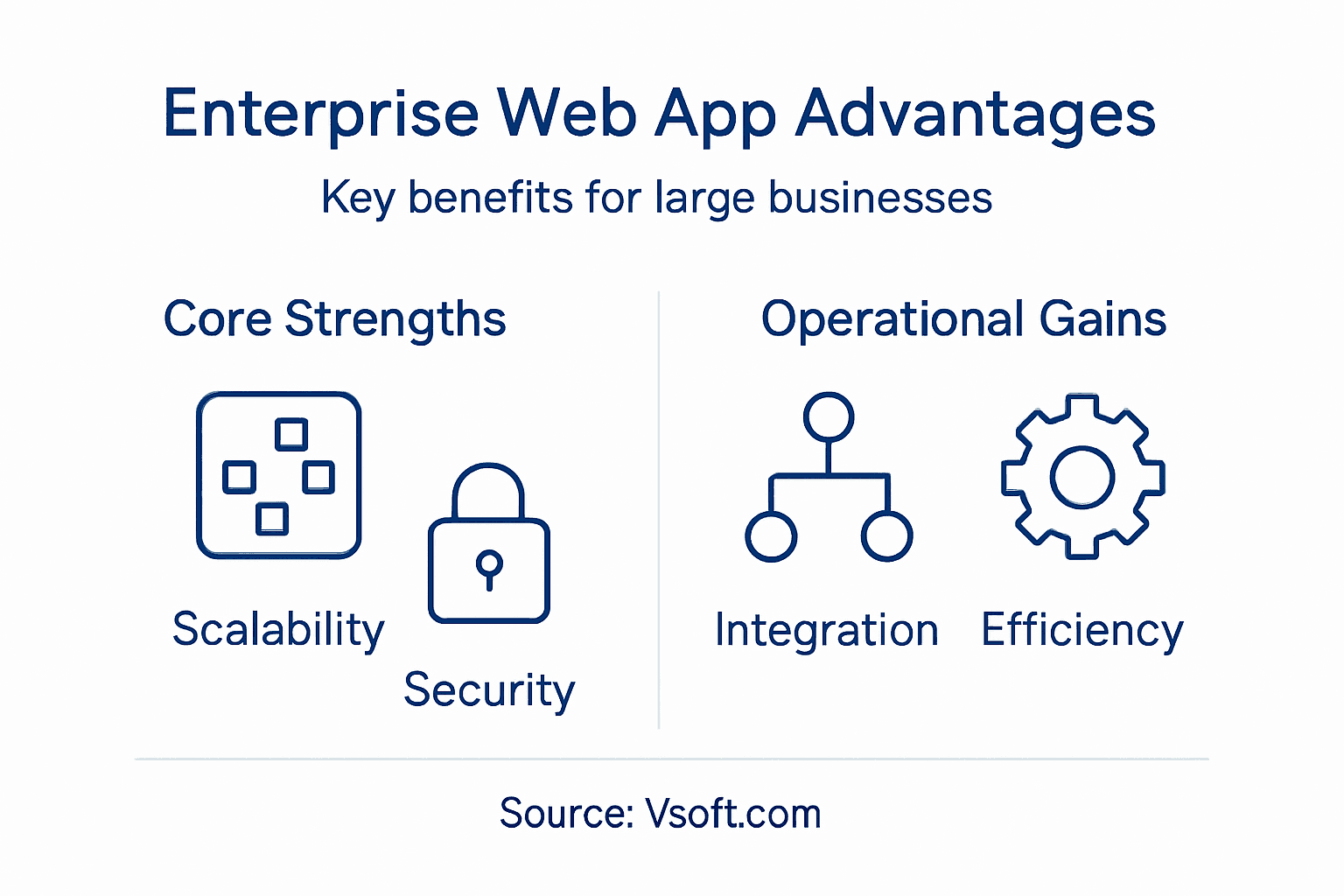
Integration capabilities represent another crucial advantage of modern enterprise web applications. By leveraging microservices architectures and advanced API technologies, organizations can create interconnected systems that enable seamless data exchange across different departments and external platforms. These integration strategies allow businesses to consolidate information from multiple sources, eliminate data silos, and create unified technological environments that enhance operational efficiency, decision-making processes, and overall organizational agility.
Pro tip: Prioritize web application architectures that offer modular design principles, allowing easier security updates and smoother system integrations over time.
Comparing Web Apps to Alternative Solutions
Enterprises face critical decisions when selecting technological solutions, and web applications increasingly replace traditional software by offering superior flexibility and performance. Unlike legacy systems confined to specific hardware or single-location access, modern web applications provide universal accessibility, enabling teams to collaborate seamlessly across different geographic locations and device platforms.
The fundamental differences between web applications and alternative solutions become evident when examining core functionality and technological infrastructure. Desktop applications typically require individual software installations, manual updates, and limited cross-platform compatibility. In contrast, web applications operate through browsers, automatically updating in real-time, supporting multiple devices, and eliminating complex deployment processes. This approach dramatically reduces IT management overhead, decreases software maintenance costs, and provides a more consistent user experience across different technological environments.
Additional comparative advantages of web applications include enhanced scalability, superior integration capabilities, and more dynamic data processing. Traditional enterprise solutions often struggle with rigid architectures that cannot quickly adapt to changing business requirements. Web applications, built on modern cloud infrastructures, can rapidly scale resources, integrate advanced analytics tools, and provide sophisticated data visualization capabilities that transform raw information into actionable business intelligence. These technological capabilities represent a quantum leap beyond conventional software solutions, offering enterprises unprecedented operational agility and technological responsiveness.
Compare web applications with traditional desktop solutions to highlight key differences:
| Characteristic | Web Applications | Desktop Solutions |
|---|---|---|
| Accessibility | Use anywhere, any device | Limited to installed machines |
| Updates | Automatic, real-time | Manual, user-dependent |
| Integration | Easy with APIs & cloud | Often siloed systems |
| Scalability | Rapid resource expansion | Rigid, hardware-limited |
Pro tip: When evaluating technological solutions, conduct thorough comparative assessments that prioritize long-term scalability, integration potential, and total cost of ownership.
Cost, Risk, and Common Pitfalls to Avoid
Enterprise web application development represents a significant technological investment that demands careful financial and strategic planning. Comprehensive service evaluation becomes critical in mitigating potential risks and controlling overall project expenditures. Organizations must conduct thorough cost-benefit analyses that extend beyond immediate implementation expenses and consider long-term operational impacts, maintenance requirements, and potential scalability challenges.
Several recurring pitfalls can substantially increase project risks and unexpected costs. Inadequate requirements gathering often leads to misaligned solutions that fail to address core business needs, resulting in expensive redevelopment cycles. Common mistakes include insufficient stakeholder consultation, unclear project scope, overlooking integration complexities with existing systems, and underestimating the technical expertise required for successful implementation. Enterprises must invest significant time in comprehensive planning, conducting detailed system assessments, and developing robust architectural frameworks that accommodate future technological evolution.
Risk management in web application development requires a multifaceted approach encompassing technological, financial, and organizational dimensions. Cybersecurity vulnerabilities, compliance challenges, and potential performance bottlenecks represent critical areas requiring proactive mitigation strategies. Successful enterprises develop holistic risk management protocols that include continuous security auditing, regular performance testing, scalable infrastructure design, and maintaining flexible technological architectures that can rapidly adapt to emerging business requirements and technological innovations.
Pro tip: Allocate approximately 20-30% of your total project budget for unforeseen challenges, contingency planning, and potential system refinements during the development and initial deployment phases.
Transform Your Enterprise with Scalable Web Application Solutions
Facing challenges such as complex operational workflows, demanding integration needs, and stringent security requirements often leaves enterprises searching for adaptable technology that evolves with them. This article highlights the critical importance of scalable architectures, modular design, and secure, integrated platforms to streamline operations and support real-time decision-making. If you are aiming to overcome common pitfalls like inflexible legacy systems or costly redevelopment cycles, embracing modern web application development is essential.
Elevate your business by partnering with experts who understand these core demands. Explore our comprehensive It Solution – Vsoft Technologies offerings that deliver custom web applications tailored to your unique enterprise needs. Enhance user experiences through intuitive interfaces with our UX Design – Vsoft Technologies services, ensuring your teams and customers benefit from seamless technology adoption.
Ready to modernize your digital infrastructure and achieve operational excellence? Visit Vsoftt.com now to start your journey toward scalable, secure, and fully integrated web application solutions designed to propel your enterprise forward. Take the next step in transforming your business with proven technology partners today.
Frequently Asked Questions
What are the benefits of enterprise web application development?
Enterprise web application development enhances organizational efficiency by streamlining operations, automating tasks, and enabling real-time data processing. These applications also support scalability and secure integration across multiple business functions.
How do enterprise web applications differ from traditional software solutions?
Unlike traditional desktop solutions, enterprise web applications are accessed through web browsers, offering automatic updates, flexible integration, and superior scalability. They eliminate the need for individual software installations and enable seamless collaboration across locations and devices.
What types of enterprise web applications are commonly used?
Common types include Customer Relationship Management (CRM) systems, Enterprise Resource Planning (ERP) platforms, Content Management Systems (CMS), and Business Intelligence (BI) dashboards, each serving specific operational purposes within an organization.
What considerations should enterprises keep in mind when developing web applications?
Organizations should focus on thorough requirements gathering, robust architectural frameworks, and proactive risk management strategies to ensure successful implementation and long-term adaptability of their web applications.