


More than 60 percent of british and global retail IT leaders believe custom web application development drives real digital transformation. Modern retail faces serious pressure to balance customer expectations with operational efficiency. For CTOs and IT managers, this article explains how web applications deliver agile, scalable solutions that reshape everything from customer experience to supply chain performance.
Table of Contents
- Defining Web Application Development In Retail
- Major Types Of Retail Web Applications
- Essential Features For Digital Transformation
- Key Benefits For Retail Enterprises
- Risks, Costs, And Common Pitfalls
- Alternatives To Custom Web App Solutions
Key Takeaways
| Point | Details |
|---|---|
| Web Application Development Enhances Retail Operations | By utilising web-based platforms, retailers can transform traditional processes into dynamic digital experiences accessible across devices. |
| Prioritise User Experience and Scalability | When developing retail web applications, focus on intuitive user design and ensure they scale effectively with business growth. |
| Address Security and Project Risks | Implement rigorous security measures and adopt agile methods to manage project challenges and technical debt. |
| Consider Alternatives to Custom Solutions | Explore Progressive Web Apps and open-source options to minimise costs and expedite implementation while maintaining flexibility. |
Defining web application development in retail
Web application development represents a sophisticated technological approach for creating interactive software solutions specifically designed to enhance retail operations through web-based platforms. These digital systems enable businesses to transform traditional transactional processes into dynamic, user-friendly digital experiences that can be accessed from multiple devices and geographic locations.
At its core, web application development involves constructing software applications that run directly within web browsers, leveraging programming languages and frameworks to create responsive, scalable solutions tailored to retail environments. Such applications integrate complex backend databases, sophisticated user interfaces, and server-side processing capabilities that support critical retail functions like inventory management, customer relationship tracking, sales analytics, and digital storefront operations.
Retail web applications typically encompass multiple strategic components including customer portals, enterprise resource planning systems, point-of-sale interfaces, and comprehensive analytics dashboards. These platforms enable seamless interactions between customers, sales teams, and backend operational systems, allowing retailers to provide personalised shopping experiences, real-time inventory updates, and sophisticated digital engagement strategies that transcend traditional brick-and-mortar limitations.
Pro tip: When developing retail web applications, prioritise user experience design and ensure cross-device compatibility to maximise customer engagement and platform accessibility.
Major types of retail web applications
Retail web applications have evolved into sophisticated digital platforms that transform traditional commerce through targeted technological solutions. These innovative systems are designed to address specific operational challenges and customer engagement strategies across different domains of retail business.
One primary category includes customer experience platforms, which integrate advanced features like personalised product recommendations, interactive shopping interfaces, and seamless omnichannel interactions. These applications leverage big data analytics to create intelligent, responsive user experiences that adapt to individual customer preferences and shopping behaviours.
Another critical classification encompasses supply chain management applications, which enable retailers to streamline inventory tracking, logistics coordination, and real-time stock management. These web applications integrate complex backend systems, providing comprehensive visibility into procurement processes, warehouse operations, and distribution networks. Additionally, progressive web applications have emerged as powerful tools that combine website accessibility with app-like functionality, offering features such as offline access, push notifications, and device-agnostic interfaces that enhance customer engagement and operational efficiency.

Pro tip: Select web application types that align closely with your specific retail business model and prioritise scalability and user experience in your digital transformation strategy.
Here is a comparison of common types of retail web applications and their core impact on business operations:
| Application Type | Main Function | Strategic Business Impact |
|---|---|---|
| Customer Experience Platforms | Personalise shopping journeys | Increase conversion and customer loyalty |
| Supply Chain Management Apps | Optimise inventory and logistics | Reduce costs, improve efficiency |
| Progressive Web Applications | Enable app-like, cross-device features | Broaden access and boost engagement |
| Analytics Dashboards | Visualise sales and performance data | Support informed, rapid decision-making |
Essential features for digital transformation
Digital transformation in retail represents a comprehensive strategic approach that fundamentally reimagines how businesses leverage technology to create more intelligent, responsive, and customer-centric operations. This profound shift goes beyond merely implementing new technologies, requiring a holistic transformation of organisational processes, culture, and technological infrastructure.
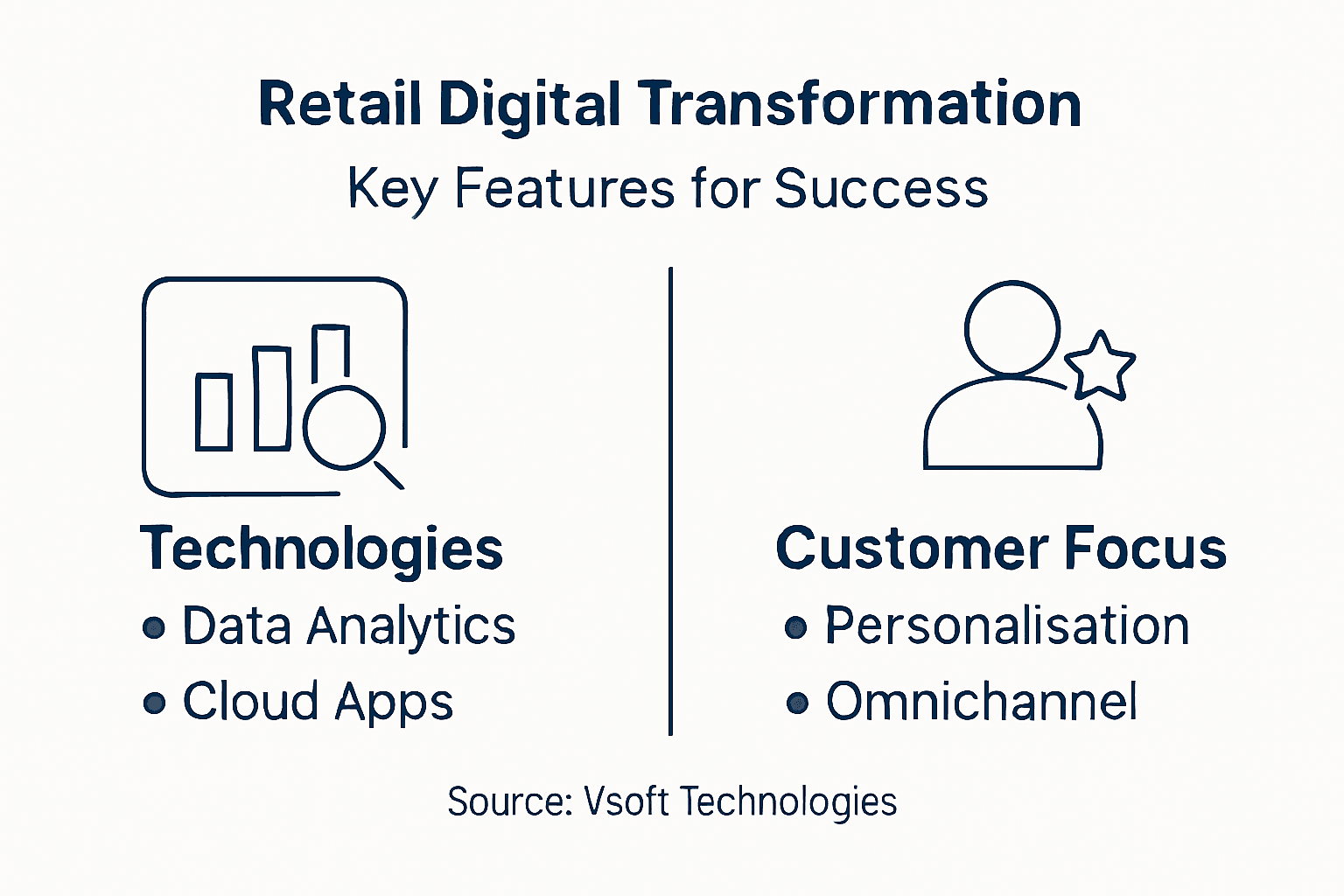
At the core of successful digital transformation lie critical technological capabilities, including advanced data analytics platforms that enable real-time insights into customer behaviour, inventory management, and market trends. These sophisticated systems allow retailers to make precise, data-driven decisions, personalise customer experiences, and optimise supply chain efficiency with unprecedented accuracy and speed.
Another crucial dimension involves developing a technological ecosystem that seamlessly integrates multiple digital channels, ensuring consistent and personalised interactions across online and offline platforms. This approach demands robust digital infrastructure that supports omnichannel strategies, enabling retailers to create fluid, interconnected experiences that adapt dynamically to changing customer preferences and market conditions. By embracing innovative organizational approaches, businesses can transform traditional retail models into agile, responsive digital enterprises.
Pro tip: Prioritise building a flexible technological architecture that can evolve rapidly and integrate emerging technologies, rather than investing in rigid, single-purpose solutions.
Key benefits for retail enterprises
Web application technologies unlock transformative opportunities for retail enterprises, enabling businesses to transcend traditional operational limitations and create more dynamic, responsive commercial ecosystems. These digital solutions represent a strategic mechanism for reimagining how retailers interact with customers, manage resources, and drive organisational performance.
Platform independence offers significant advantages for modern retail organisations, allowing seamless service delivery across multiple devices and technological environments. By implementing web applications, retailers can establish consistent user experiences that adapt dynamically to different screen sizes, operating systems, and user preferences, effectively eliminating technological barriers that might previously have restricted customer engagement.
Moreover, web application development provides retailers with powerful tools for operational optimisation, including enhanced automation capabilities, real-time data analytics, and sophisticated customer interaction platforms. These technological solutions enable businesses to streamline complex processes, reduce manual administrative overhead, and create more intelligent, responsive commercial strategies that can rapidly adapt to changing market conditions and consumer expectations.
Pro tip: Invest in scalable web application architectures that prioritise flexibility and interoperability, ensuring your technological infrastructure can evolve alongside emerging business requirements.
Risks, costs, and common pitfalls
Web application development in retail represents a complex technological journey fraught with potential challenges that can significantly impact operational effectiveness and financial investment. Organisations must approach these digital transformation initiatives with strategic awareness and comprehensive risk management strategies to mitigate potential negative outcomes.
Security vulnerabilities pose substantial risks for retail enterprises, potentially exposing critical business systems and customer data to malicious exploitation. These risks encompass multiple dimensions, including broken access controls, potential injection attacks, and cryptographic vulnerabilities that could compromise entire digital infrastructure. Retailers must implement rigorous security protocols, conduct regular vulnerability assessments, and maintain robust authentication mechanisms to protect against potential systemic breaches.
Moreover, technological development risks extend beyond immediate security concerns, encompassing broader project management challenges such as budget overruns, schedule delays, and scope creep. Retail organisations frequently encounter technical debt, where expedient short-term solutions accumulate complexity and maintenance challenges over time. These challenges can inflate development costs, reduce system performance, and create long-term operational inefficiencies that undermine the initial digital transformation objectives.
Pro tip: Implement a comprehensive risk management framework that includes regular security audits, continuous technical debt assessment, and agile development methodologies to proactively identify and mitigate potential systemic vulnerabilities.
The following table outlines key risks in retail web application development and practical remedies:
| Risk Category | Example Challenge | Practical Mitigation Strategy |
|---|---|---|
| Security Vulnerabilities | Exposure of customer data | Regular security audits and updates |
| Project Overruns | Budget or timeline issues | Realistic planning and agile methods |
| Technical Debt | Long-term maintenance issues | Continuous refactoring and testing |
Alternatives to custom web app solutions
Retail enterprises seeking digital transformation have multiple alternatives to traditional custom web application development, each offering unique advantages and potential cost-saving strategies. These alternatives provide flexible approaches to technological innovation without requiring extensive in-house development resources.
Progressive Web Apps represent a sophisticated alternative that delivers app-like experiences using standard web technologies. These solutions enable retailers to create cross-platform applications with offline functionality, seamless updates, and enhanced user engagement without the complexities of platform-specific development. PWAs offer remarkable flexibility, allowing businesses to reach customers across multiple devices while maintaining a consistent, responsive digital experience.
Open-source web applications provide another compelling alternative, offering pre-built solutions for critical retail functions such as inventory management, customer relationship systems, and digital storefronts. These platforms dramatically reduce initial development costs, accelerate implementation timelines, and benefit from continuous community-driven improvements. Retailers can leverage these solutions to quickly deploy robust digital infrastructure while maintaining the ability to customise and scale according to specific business requirements.
Pro tip: Evaluate alternative solutions by conducting thorough proof-of-concept testing, assessing integration capabilities, and measuring potential long-term total cost of ownership against custom development approaches.
Unlock the Full Potential of Retail with Expert Web Application Development
Retailers face critical challenges in delivering seamless, personalised digital experiences that truly engage customers across multiple platforms. The need for scalable, secure, and user-centric web applications is more important than ever to optimise inventory management, streamline supply chains, and support data-driven decision-making. At the heart of these goals is the ability to leverage agile technologies and innovative design to transform traditional retail models into dynamic digital enterprises.
Discover how Vsoft Technologies can help you overcome these obstacles through tailored web application development and expert UX Design. Whether you seek to enhance customer experience platforms or integrate advanced analytics dashboards, our solutions empower your business to stay competitive, secure, and efficient.
Explore cutting-edge mobile solutions with our specialized Mobile App services designed for seamless cross-device operation.
Take the next step towards redefining your retail digital infrastructure today. Visit Vsoft Technologies and partner with us to create sophisticated, scalable web applications that elevate your retail business now.
Frequently Asked Questions
What is web application development in retail?
Web application development in retail refers to creating interactive software solutions that enhance retail operations through web-based platforms, allowing for dynamic and user-friendly digital experiences accessible from various devices.
What are the major types of retail web applications?
The major types of retail web applications include customer experience platforms, supply chain management applications, progressive web applications (PWAs), and analytics dashboards, each designed to optimise specific retail functions and improve customer engagement.
Why is digital transformation important for retail businesses?
Digital transformation is crucial for retail businesses as it enables them to utilise technology to create more responsive and customer-centric operations, improve decision-making through data analytics, and integrate multiple digital channels for a seamless shopping experience.
What are the risks associated with web application development in retail?
Risks include security vulnerabilities that could expose customer data, project management challenges such as budget overruns and schedule delays, and the accumulation of technical debt, which can impair long-term system performance and increase maintenance costs.